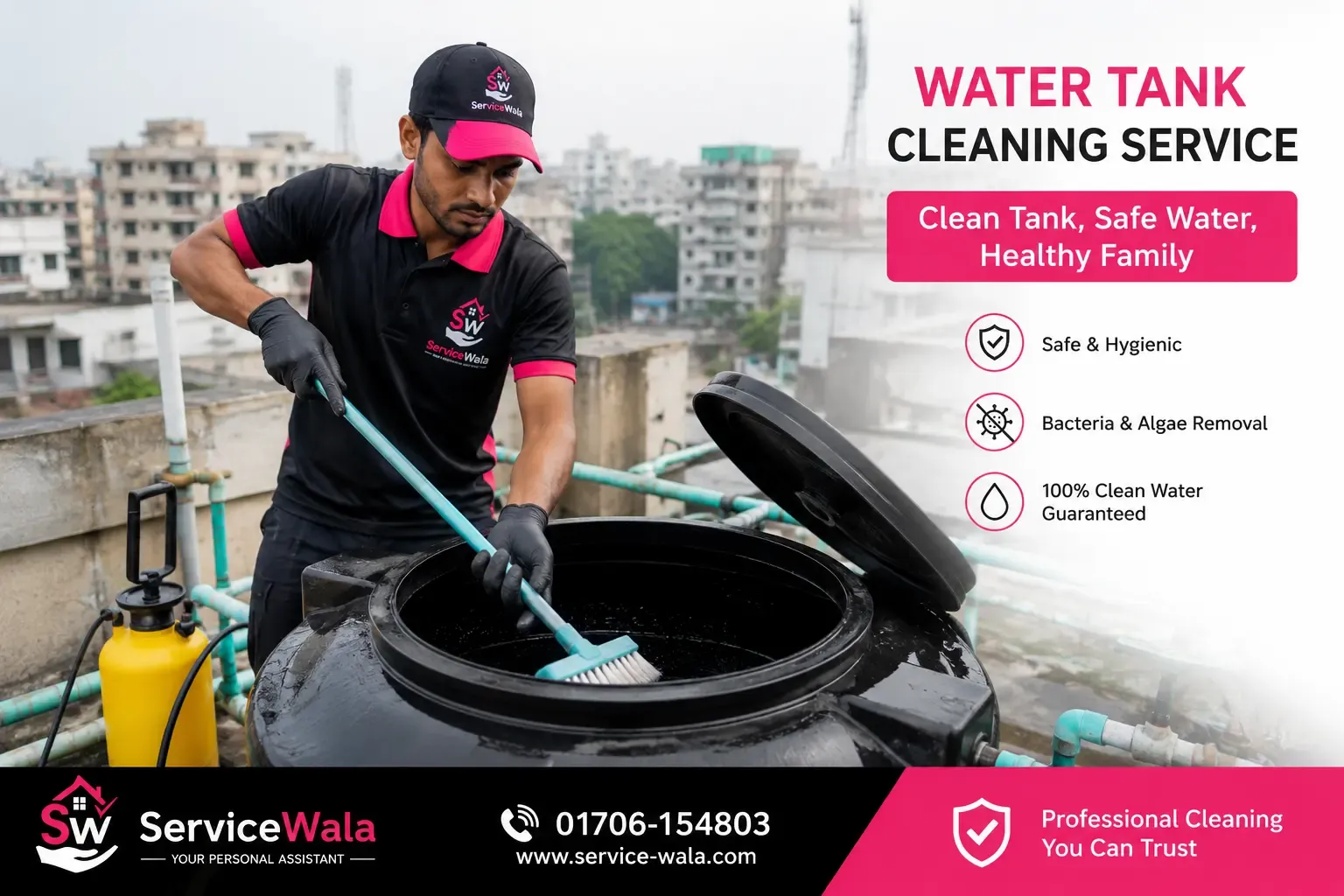
Nadia had been buying bottled water for her family for years. Not because her building had no water supply — but because the water from the tap had a strange smell. Sometimes it looked slightly cloudy. Her children complained of stomach problems regularly.
One day, the building's maintenance team opened the overhead water tank for a routine check. What they found inside shocked everyone — thick green algae coating the walls, dark sediment at the bottom and a layer of slime that had been building up for years.
The water her family had been using for bathing, washing dishes and occasionally drinking — had been passing through that tank every single day.
After one proper cleaning by Service Wala, the difference was immediate. The smell was gone. The water ran clear. And within weeks, her children's stomach issues had noticeably improved.
Your water tank tells you nothing. It just sits on your roof or underground — quietly collecting whatever grows inside. That is why cleaning it regularly is not optional — it is essential.
What Grows Inside an Unclean Water Tank?
Most people assume their water is clean because it comes through pipes. But pipes carry water into your tank — not out of it. Whatever grows inside your tank goes directly into your taps.
Here is what builds up inside a neglected water tank —
🦠 Bacteria and Pathogens
Tanks that are not cleaned become breeding grounds for harmful bacteria including E. coli and Salmonella. These cause diarrhea, vomiting, typhoid and serious gastrointestinal illness — especially dangerous for children and elderly family members.
🌿 Algae Growth
Sunlight reaches many overhead tanks — especially those without proper covers. Algae grows rapidly in warm, still water. It gives water a green tint, a foul smell and makes it completely unsafe for any use.
🟤 Sediment Buildup
Over time, dust, sand and mineral deposits settle at the bottom of the tank. This sediment gets stirred up every time water is pumped in — entering your pipes and taps as dirty, cloudy water.
🐛 Insects and Contamination
Tanks with damaged or missing covers allow insects, lizards and even birds to enter. Their presence — and what they leave behind — contaminates the entire water supply.
How Often Should You Clean Your Water Tank?
This is the question most people never ask — until something goes wrong.
If your area has poor water quality or your tank has no proper cover — clean more frequently. Six months is the maximum gap for any household tank.
How We Clean Your Water Tank
Most people think cleaning a water tank means just draining it and rinsing it out. That is not enough — and it does not remove bacteria, algae or biofilm from the walls.
Here is exactly how our team does it —
✅ Step 1 — Water Drainage
We safely drain all water from the tank before starting. For underground tanks, we use pumping equipment.
✅ Step 2 — Manual Scrubbing
Our team enters or reaches into the tank and manually scrubs every wall, corner and surface — removing algae, slime and sediment that simple rinsing cannot reach.
✅ Step 3 — High-Pressure Washing
After scrubbing, we use high-pressure water to wash down all surfaces — flushing out loosened debris completely.
✅ Step 4 — Disinfection
We apply food-grade disinfectant to kill all remaining bacteria, viruses and pathogens. This is the step most local cleaners skip — and the most important one.
✅ Step 5 — Final Rinse & Inspection
After disinfection, we do a final rinse and inspect the tank — checking for cracks, damaged inlet/outlet pipes and cover condition. We inform you of any issues found.
✅ Step 6 — Refill
Tank is refilled and ready for use.
What Makes Our Cleaning Different
Many building caretakers offer to clean water tanks — usually with a basic rinse and nothing more. The bacteria and biofilm on the walls remain. Within weeks, contamination returns.
At Service Wala —
✅ We scrub every surface — walls, floor and all corners
✅ We use food-grade disinfectant — safe for drinking water tanks
✅ Our team wears proper protective gear — hygienic throughout
✅ We check inlet, outlet and overflow pipes during cleaning
✅ We inform you of any damage or issues found in the tank
✅ No hidden charges — price confirmed before we start
Our Other Services
Pricing
⚠️ Final price confirmed after assessing tank size and condition.